 ArdenAlgo
Displacement
- Displacement means one candle body at least 1.5x the average body of the prior 20 bars.
- It is the single filter that separates a structure break with conviction from drift.
- No displacement means no MSS, no order block and no qualified FVG — the whole sequence stops.
What it is
Every ICT-style sequence eventually asks one question: did that move mean anything? Displacement is this engine's answer, expressed as arithmetic rather than adjectives. A leg displaces when at least one candle body dwarfs recent bodies — not because big candles are magic, but because a body that size is evidence that one side cleared the book instead of drifting.
Where it sits in the chain
Displacement is not a signal — it is a gate placed in front of three other concepts. A structure break without it is not an MSS. A three-candle gap without it is not a qualified FVG. An opposite candle without it is not an order block. That is why one parameter can quietly halve the number of signals a week produces.
Common misuse
Judging displacement by eye, chart by chart, which reliably finds it wherever you already wanted a trade. Relative-to-recent-average is boring and mechanical, and that is the entire point.
Common questions
Why 1.5x and not some other multiple?
It was fixed before any data was collected and frozen with mechanization v1. That number can be wrong, but it cannot be tuned after seeing results — changing it creates a new version with a dated changelog entry.
Is displacement the same as a big candle?
It is relative, not absolute: the same 200-point candle passes in a quiet market and fails in a volatile one, because the yardstick is the recent 20-bar average body.
What if a move is strong but has no gap?
It does not qualify. The engine wants both energy and the inefficiency it leaves behind, because the gap is what later becomes the entry.
On a real chart
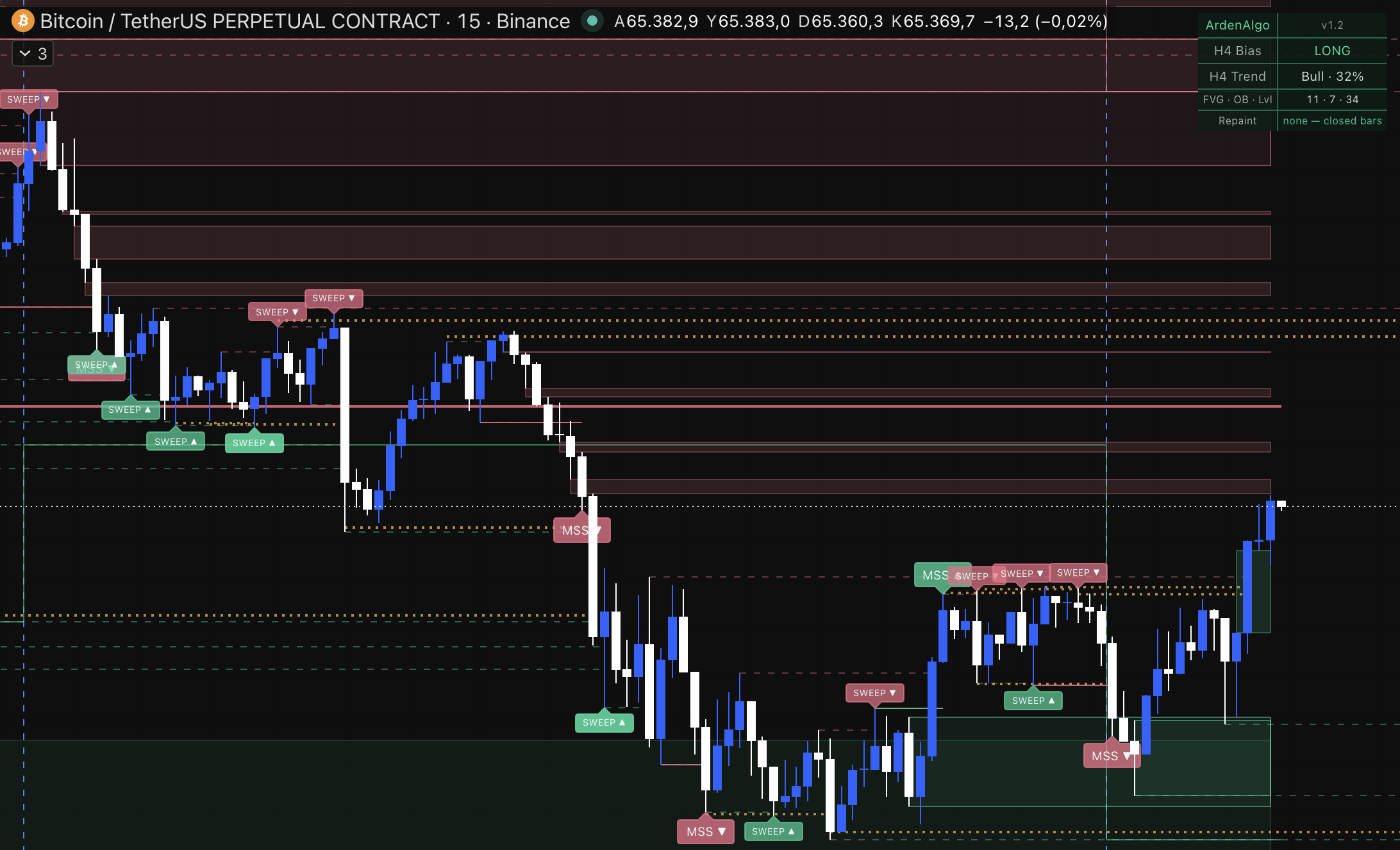
The engine's markings on a live chart — a screenshot from our TradingView showcase, not an illustration.
Related
Market structure shift · Fair value gap · Full methodology
Joining locks the launch rate before the evaluation verdict is out — and gets you two mails, ever: launch + the verdict, whichever way it goes.