ArdenAlgo runs a deterministic ICT/SMC engine on crypto perpetual futures and writes every signal to a public ledger — entries, stops, targets, costs and outcomes. Losses included. Signals recorded before results exist; nothing ever deleted.
The numbers below come straight from the engine's database — the same one our own research reads. Every record is timestamped before the result is known, and net figures include modeled taker fees, slippage and funding.
auto-refreshes — updated 0s ago
| Closed (UTC) | Symbol | Side | Outcome | Net bps |
|---|---|---|---|---|
| 26 Oct 23:15 | LAUSDT | LONG | ✕ STOP | ▼ -166 |
| 26 Oct 16:45 | NEARUSDT | LONG | ✕ STOP | ▼ -274 |
| 26 Oct 05:00 | BNBUSDT | SHORT | ✕ STOP | ▼ -66 |
| 26 Oct 04:45 | ONUSDT | SHORT | ✕ STOP | ▼ -259 |
| 25 Oct 15:30 | NEARUSDT | LONG | ✓ TARGET | ▲ +57 |
Same data in, same output out — every detection is reproducible and testable. No discretionary "confluence" hand-waving.
Everything is evaluated on closed bars; swing pivots confirm with a delay on purpose. A signal that exists never un-exists.
Prior day/week highs & lows and clustered equal levels — the pools where stops actually rest — tracked per symbol, per session.
A wick-take with a body close back, then a displacement-validated structure shift, then an FVG retest. Only the full sequence fires.
Taker fees, slippage and funding are baked into every net figure on the ledger. Gross-only results are how this industry lies politely.
The engine is in a pre-registered live evaluation with frozen thresholds. Pass or fail, the verdict goes on this site.
"Smart money concepts" tools usually hide behind vague language. Ours are exact — the same thresholds the engine runs are printed below and documented in full in the methodology.
Where stops actually rest: prior day/week highs & lows and clustered equal highs/lows. The engine hunts reactions at these pools — not arbitrary support/resistance.
A wick trades through a mapped level but the body closes back on the original side — stops taken, move rejected. A body close beyond is a run, not a sweep, and is ignored.
After the sweep, the last opposing swing must break — by body close, inside a leg showing real displacement. That's the confirmation that the rejection has teeth.
The three-candle inefficiency left behind by displacement. The entry is the last FVG of the confirming leg, taken on the retest — not on the breakout candle.
The final opposite candle before a displacement leg that also created an FVG — the footprint of the move's origin. Zones must be untapped and on the correct side of the range.
The H4 dealing range is split at its midpoint: longs are only hunted from discount, shorts only from premium. No bias, no trade — the engine simply waits.
A real setup the engine flagged before the outcome was known, and what happened next. Every number in the video comes straight from the ledger below — you can open it and check the same trade.
A higher timeframe sets the bias, the one below it supplies the zone, the lowest runs the confirmation state machine. No stage can be skipped, every stage has a timeout — the diagram below is the whole story.
Closed bars only · deterministic · sweep→MSS 16 bars · MSS→retest 32 bars · 48h expiry · 4h cooldown · alerts at R:R ≥ 1.5 · costs modeled — all thresholds, in full →
H4 bias set, H1 zone touched. The engine starts watching — and only now can a sweep mean anything.
Wick through a mapped level, body closes back. The clock starts: 16 bars for structure to answer.
Last opposing swing breaks by body, with displacement and an FVG in the leg. 32 bars for the retest.
Price retests the leg's last FVG. The full plan — entry, stop, target, R:R — hits Telegram and the ledger at once.
Every alert carries the full trade plan — entry zone, invalidation, liquidity target and risk:reward — and every alert is simultaneously written to the public ledger. You can check any alert you ever received against the permanent record. That's the accountability loop no screenshot can fake.
Format shown with a real signal from the public ledger — not a curated example.
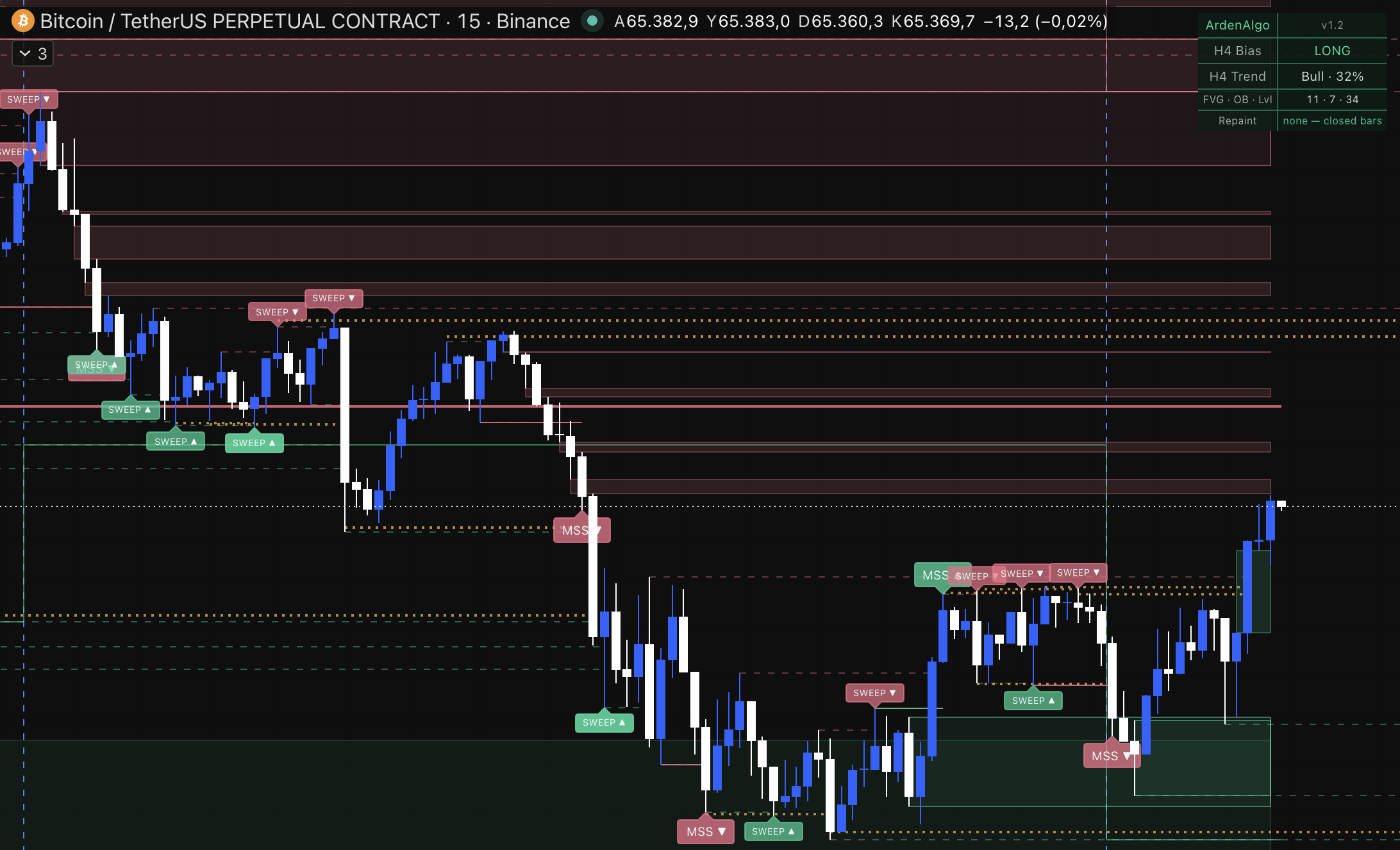
Our free TradingView indicator visualizes the engine's building blocks with matching definitions: the liquidity map, sweeps, displacement MSS marks, FVG/OB zones and an H4 bias panel — plus six alert conditions.
Screenshots on this site are the actual v1.2 build on live charts — not mockups.
Two free companion scripts (same definitions, same closed-bar rule): a multi-symbol scanner ↗ that tables up to 18 markets by which conditions printed on the last closed bar, and a session & volatility context panel ↗ that tallies FVG fill and sweep follow-through per session block × volatility tercile — on your chart, with the sample size next to every number. Neither states a result.
Signal quality is an open question until the evaluation answers it — engineering quality isn't. This is the part we can already prove.
The engine, notifier and site run as supervised system services with automatic restart — not a script in someone's terminal.
Every component emits heartbeats; if the engine goes quiet, this site flags itself STALE within 30 minutes. The status you see is the status there is.
Signal events cannot be updated or deleted — the database refuses it, and every row is hash-chained to the one before. The outcome is attached to its row once, when it becomes known. The site reads all of it with read-only access.
Detection replays in the automated test suite on every change — same bars in, same events out, or the suite fails.
Fees, slippage and funding come from a single versioned model reused across our research — never tuned per marketing page.
Detection, accounting, the ledger API and this very site ship behind a green test suite. The number is not a slogan: a test asserts it matches the suite exactly, so it cannot quietly go stale.
Most tools in this niche ship claims first and evidence never. We run it in reverse: a pre-registered gate ladder, thresholds frozen before data arrived, every verdict published. Nothing is sold as more than a scanner until the ladder says otherwise.
Determinism tests plus a bar-by-bar cross-check against TradingView chart data — the engine sees exactly what a human sees, and the same input always yields the same output.
Every signal trades on paper, in public. When the sample completes — 60 closed trades, or 42 days with at least 30 — the pooled result is tested against a random-entry benchmark with all costs modeled. Thresholds were frozen before any data arrived. We publish the verdict either way.
Only if the pooled result warrants it: per-hour and per-symbol analysis under split-half validation — never cherry-picked cells.
Four more weeks of live forward records after the evaluation, required to stay positive net of costs before anything is sold as more than a scanner.
| ArdenAlgo | Typical signal service | |
|---|---|---|
| Results shown | Full public ledger — losses included | Cherry-picked screenshots |
| Costs | Fees, slippage & funding in every net figure | Gross moves, costs ignored |
| Repaint | Closed bars only, by design | Often unstated |
| Validation | Pre-registered live test, verdict published | "Trust us" |
| Cancellation | Self-serve, plus a reminder before renewal | Auto-renew friction |
| Method | Published definitions, versioned & frozen | "Proprietary AI confluence" |
| Social proof | A database, readable by anyone | Unverifiable member counts |
| Track record | Forward-only live ledger — no backtest anywhere | Backtest screenshots, parameters chosen after the fact |
| Price | One published rate, locked for founding subscribers | Evergreen "50% off" codes against a list price nobody pays |
Not values on a wall — testable commitments. Each one is verifiable on this site today, and each one stays binding after launch.
Every plan runs on the same engine and reads the same ledger — Pro buys delivery speed and detail, not better signals. The rates below are exact, not a teaser: we publish them before checkout even exists, because the waitlist locks this rate and a locked rate you haven't seen isn't a promise. If they change before launch, that change gets a dated changelog entry like everything else here.
Launch rates — checkout doesn't exist yet, so nothing is charged today. Join the waitlist and this exact rate is the one you lock.
| Plan difference, in numbers | Pro | Open |
|---|---|---|
| Price | $24/mo · $199/yr | $0 |
| Telegram delivery | real-time, the moment the bar closes | one digest a day, after the fact |
| Markets on Telegram | all 26 | 2 (BTC + ETH) |
| Detail per signal | entry zone · invalidation · target · R:R | outcome, once it's on the ledger |
| Public ledger + JSON API | identical — full history | identical — full history. The record is never paywalled. |
| Leaving | self-serve cancel · 30-day money-back on the first payment | nothing to cancel |
Billing, honestly: subscriptions auto-renew — monthly plans each month, the annual plan once a year — and we e-mail you before any renewal charges you. Cancelling never requires talking to anyone, and both plans carry the same 30-day money-back on the first payment. Payments will be processed by an established merchant-of-record provider — named on the billing promise page before checkout opens. Prices are never hidden behind a sign-up.
Speed and detail of delivery — nothing else. The signals are identical to the ones recorded on the free public ledger. Open gets them as a once-a-day digest covering BTC + ETH; Pro gets every market in real time, each alert carrying the full trade plan (entry zone, invalidation, target, R:R) and a link to its permanent ledger row. If the free ledger already tells you everything you need, don't subscribe — it stays free either way.
Three reasons. The waitlist locks the launch rate, and a lock on an unpublished number would be meaningless. Deciding calmly beats deciding at a checkout page. And this category's habit of revealing prices only after sign-up is one of the patterns this site exists to not repeat. The band we published earlier said $19–29/mo — the final rate lands inside it, and the resolution is a dated changelog entry.
Because there is one engine and one ledger, and every subscriber gets all of it. A second paid tier would have to hold something back from the first — or invent something new to gate. Vendors in this category commonly ladder two or three tiers into three-digit monthly prices; we sell delivery of one thing and price it once.
The product is identical on both; only the bill changes. Annual is $199 charged once a year — 31% less than twelve monthly payments — and monthly keeps your commitment at one month. Both carry the 30-day money-back on the first payment, and joining from the waitlist locks whichever rate you start on. Honest default: start monthly, judge the service against its own ledger, switch if it earns it.
The verdict is published either way, prominently. On a fail, the product remains what it demonstrably is — a deterministic scanner with an honest, append-only ledger — and is priced and described as exactly that. You'll never see a fail buried or spun.
An established merchant-of-record provider (named before checkout opens) handles payment, invoices and VAT — we never see or store card numbers. Details live on the billing promise and privacy pages.
Open the live ledger and judge the engine on its full record — entries, exits, costs, losses. No account, no e-mail, no paywall.
One field, one click. You'll get the launch rate before anyone else, plus the evaluation verdict the day it lands.
Pro subscribers get every signal in real time with the full trade plan — each one permanently recorded in the same public ledger you can already read.
No. Everything is computed on closed bars; swing pivots confirm with a deliberate delay. A drawing or alert, once printed, never changes. This is a design constraint of the engine, not a marketing claim — the methodology page documents exactly how.
We don't know, and we won't pretend to. That is precisely why the ledger is public and the evaluation is pre-registered: judge the evidence yourself. Nothing on this site is financial advice, and past results — paper or real — do not predict future returns.
A live database of every signal the engine produces: entry zone, invalidation, target, timestamps, modeled costs and the outcome. Rows are written before the result is known and are never edited or removed — including the losses.
We publish the verdict either way. If the engine can't beat a random-entry benchmark after costs, that goes on this site and the product stays a scanning/education tool — clearly labeled as such.
Crypto USDT-M perpetual futures — currently a fixed universe of liquid majors tracked 24/7. The exact list is on the ledger page.
Mechanically, we use published, deterministic definitions instead of proprietary "AI confluence". Commercially, we show a full audited ledger instead of testimonials and win-rate screenshots — and we test against a null benchmark before selling signal quality.
No. "ICT" and "Inner Circle Trader" refer to concepts popularized by Michael J. Huddleston. ArdenAlgo is not affiliated with, endorsed by, or connected to him in any way — we mechanize a documented interpretation of these public-domain concepts.
Yourself, from your account page, at any time — no support chat, no phone call — and we e-mail you before any renewal. Renewal friction is endemic in this category; refusing it is written policy here: the billing promise.
Exchange-based OHLCV for USDT-M perpetual futures — crypto plus gold and silver — consumed on closed bars at whichever timeframe the scale runs on. The engine is provider-agnostic by design; the licensed data provider for the paid product will be named here and in the methodology before launch, with a changelog entry.
No. Nothing here connects to your exchange account, holds funds, or executes orders. Alerts are information; every decision — and every key — stays with you.
Result in basis points (1 bp = 0.01%) after modeled taker fees, slippage and funding — the costs most services quietly ignore. "Gross" is the raw move; "net" is what surviving those costs would have left.
Because the engine is selective by construction: one full sweep→MSS→retest sequence per signal, with cooldowns. We'd rather show you a small honest sample than pad it with noise — and the small-sample label stays on until N ≥ 30.
The signal industry runs on screenshots. Here's why we chose a database anyone can audit instead, and what it commits us to.
24 Jul 2026 · 5 min EngineeringRepaint isn't bad luck — it's a design choice. Closed bars, delayed pivots and determinism: how the engine makes repainting impossible.
24 Jul 2026 · 6 min ResearchFrozen thresholds, a random-entry benchmark and a pre-registered sample trigger — the evaluation, explained.
24 Jul 2026 · 7 minWhat joining actually gets you — three things, nothing vague:
Two e-mails total. Your address is never shared, and removal is one reply.
 ArdenAlgo